Real Life Application Examples
1. Selecting a Marketing Focus Group
A company is conducting market research and needs to form a focus group of 6 people out of 15 candidates. Due to diversity requirements, exactly 3 of the 6 must be from Region A, and the remaining 3 must be from Region B. There are 8 candidates from Region A and 7 from Region B. How many ways can the focus group be chosen?
Solution
First, choose 3 people from Region A (8 candidates available):

Next, choose 3 people from Region B (7 candidates available):

Multiply these results to get the total number of ways to form the focus group:

Answer:There are 1,960 ways to form the focus group.
2. Selecting a Committee with Expertise Requirements
An engineering firm needs to create a 5-member committee from a pool of 12 employees. The committee must include at least 2 experts in cybersecurity. If there are 4 cybersecurity experts in the pool, how many ways can the committee be chosen?
Solution
We will evaluate all possible cases where the committee includes at least 2 cybersecurity experts.
Case 1: Choose 2 cybersecurity experts and 3 non-experts.
• Ways to choose 2 cybersecurity experts from 4:

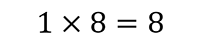
• Ways to choose 3 non-experts from the remaining 8:

• Total ways for this case:

Case 2: Choose 3 cybersecurity experts and 2 non-experts.
• Ways to choose 3 cybersecurity experts from 4:

• Ways to choose 2 non-experts from the remaining 8:

• Total ways for this case:

Case 3: Choose 4 cybersecurity experts and 1 non-expert.
• Ways to choose 4 cybersecurity experts from 4:

• Ways to choose 1 non-expert from the remaining 8:

• Total ways for this case:
Final Calculation
Now we add the results from all cases to get the total number of ways to form the committee with at least 2 cybersecurity experts:

Answer:There are 456 ways to form the committee under these requirements.
3. Designing a Lunch Menu
A restaurant offers 9 different side dishes and wants to create a lunch special with 4 side dishes. The lunch special must include at least 1 vegetarian option out of the 3 vegetarian side dishes. How many different lunch specials can be created?
Solution
We will consider all cases where the lunch special includes at least 1 vegetarian dish.
Case 1: Choose 2 cybersecurity experts and 3 non-experts.
• Ways to choose 1 vegetarian side dish from 3:

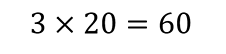
• Ways to choose 3 non-vegetarian side dishes from the remaining 6:

• Total ways for this case:
Case 2: Choose 2 vegetarian and 2 non-vegetarian dishes.
• Ways to choose 2 vegetarian side dishes from 3:
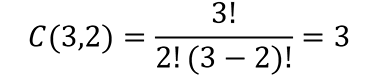
• Ways to choose 2 non-vegetarian side dishes from the remaining 6:

• Total ways for this case:

Case 3: Choose 3 vegetarian and 1 non-vegetarian dish.
• Ways to choose 3 vegetarian side dishes from 3:
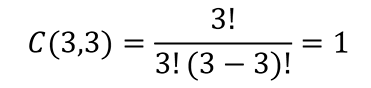
• Ways to choose 1 non-vegetarian side dish from the remaining 6:

• Total ways for this case:

Final Calculation
Now we add the results from all cases to get the total number of ways to create lunch specials with at least 1 vegetarian option:

Answer:There are 111 different lunch specials possible.
4. Math and English Books
If 4 Maths books are selected from 6 different Maths books and 3 English books are chosen from 5 different English books, how many ways can the seven books be arranged on a shelf if:
a) There are no restrictions?
b) The 4 Maths books remain together?
c) A Maths book is at the beginning of the shelf?
d) Maths and English books alternate?
Solution
Step 1: Calculating the Number of Ways to Select the 7 Books
• Selecting 4 Maths books out of 6:

• Selecting 3 English books out of 5:

• Total number of ways to select the 7 books:

So, there are 150 ways to select the set of 7 books.
Step 2: Arranging the Selected Books on a Shelf
Once the books are selected, we can arrange them in various ways depending on the conditions in each part of the question.
a) No Restrictions
Since there are no restrictions, we simply arrange the 7 books in any order. The number of arrangements of 7 distinct books is:

So, with no restrictions, there are 756,000 ways to arrange the 7 books.
b) The 4 Maths Books Remain Together
If the 4 Maths books remain together, we can treat these 4 Maths books as a single "block".
This gives us 4 books in total to arrange: 1 "block" of Maths books and 3 individual English books.
• Arranging the 4 "blocks" (1 Maths block and 3 English books):
The 4 blocks can be arranged in 4! ways:

• Arranging the 4 Maths books within their block:
Since the Maths books are distinct, we can arrange them in 4! ways within the block:
• Total number of ways to select the 7 books:

So, with the 4 Maths Books remain together, there are 86,400 ways to arrange the 7 books.
c) A Maths book is at the beginning of the shelf
• Place a Maths Book at the Beginning:
•
There are 4 chosen Maths books (from the initial selection process). Any one of these 4 Maths books can be placed at the beginning of the shelf.
•
So, we have 4 choices for the Maths book in the first position.
• Arranging the Remaining 6 Books:
•
Now, with the remaining 3 Maths books and 3 English books, we can arrange these 6 books in 6! ways.

• Total Calculation:
•
Multiply the choices for the first Maths book by the number of ways to select the remaining 6 books and then by the number of arrangements of these 6 books:

If a Maths book is required to be at the beginning of the shelf, there are 432,000 ways to arrange the 7 books on the shelf.
d) Maths and English books alternate?
Given that there are 4 Maths books and 3 English books, there are only two feasible alternating patterns:
Pattern 1:

Pattern 2:
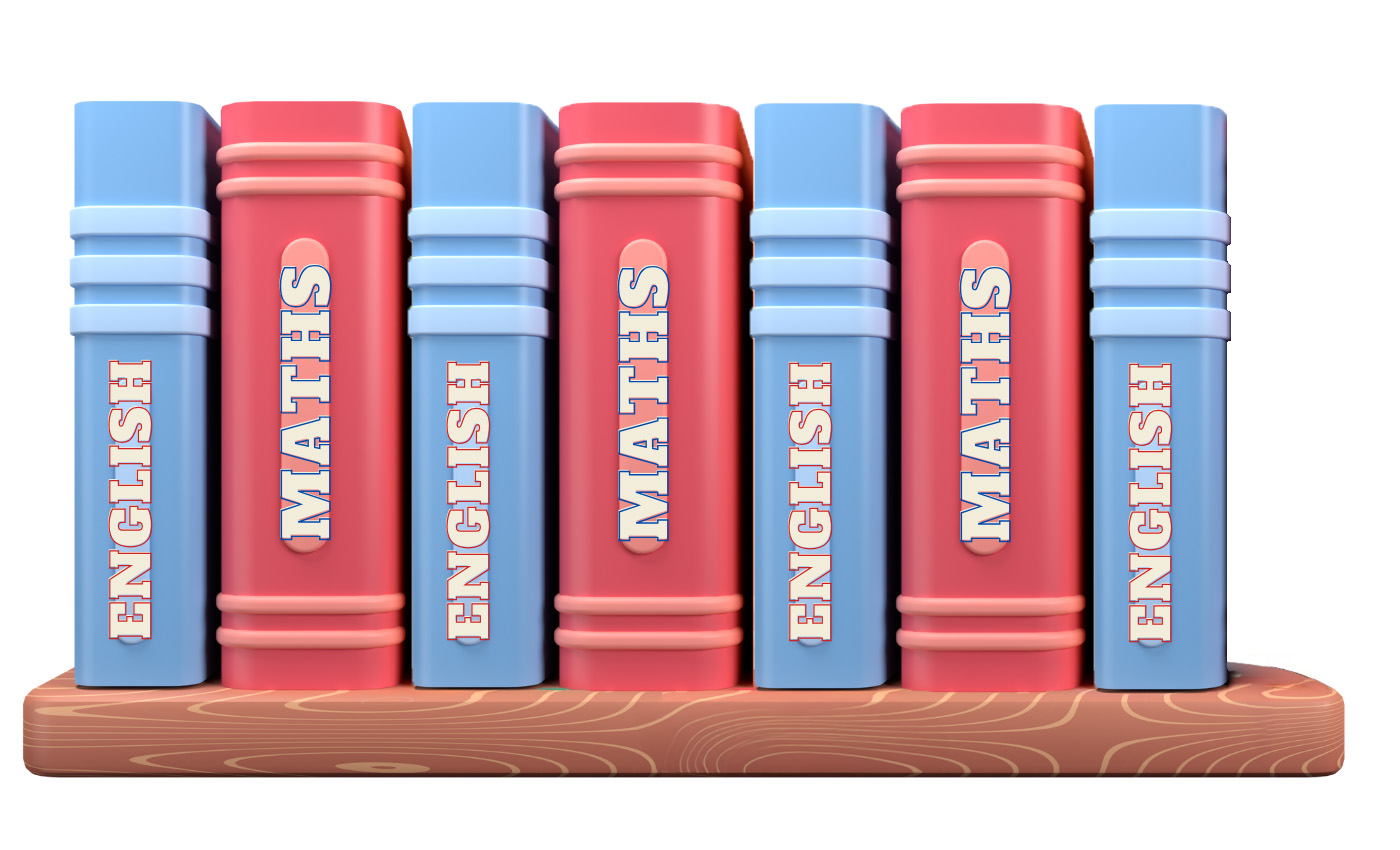
Since we have 4 Maths books and 3 English books, only Pattern 1 is possible (starting with a Maths book and alternating with English books).
Solution Steps
1. Selecting the Books:
•
Choose 4 Maths books from 6 available Maths books:

•
Choose 3 English books from 5 available English books:

•
Total ways to select the books: 15×10=150
2. Arranging the Books in the Alternating Pattern:
•
With the alternating pattern (Maths - English - Maths - English - Maths - English - Maths), we have 4 slots for Maths books and 3 slots for English books.
•
Arranging the 4 Maths books in the 4 Maths slots:
•
Arranging the 3 English books in the 3 English slots:

3. Calculating the Total Arrangements:
•
Multiply the number of ways to select the books, the arrangements of the Maths books in their slots, and the arrangements of the English books in their slots:

If the Maths and English books alternate, there are 21,600 ways to arrange the 7 books on the shelf.